













Short answer: Most families move through caregiving in stages: crisis, stabilization, organization, and longer-term sustainability. The fastest way to feel less overwhelmed is to stop trying to solve everything at once and focus on the right priorities for the stage you are in. Crisis needs safety and clarity. Stabilization needs routines and information. Long-term care needs boundaries, support, and realistic expectations.
Caregiving can feel chaotic because the role often begins in motion. A hospitalization, a fall, a sudden diagnosis, or a slow decline that finally becomes undeniable can push a family into action before anyone feels ready. In that moment, everything seems urgent, and it is easy to confuse “everything matters” with “everything must be solved today.”
This roadmap is designed to help you think more clearly. It gives you a stage-based way to understand what is happening, what matters most right now, and what usually comes next.
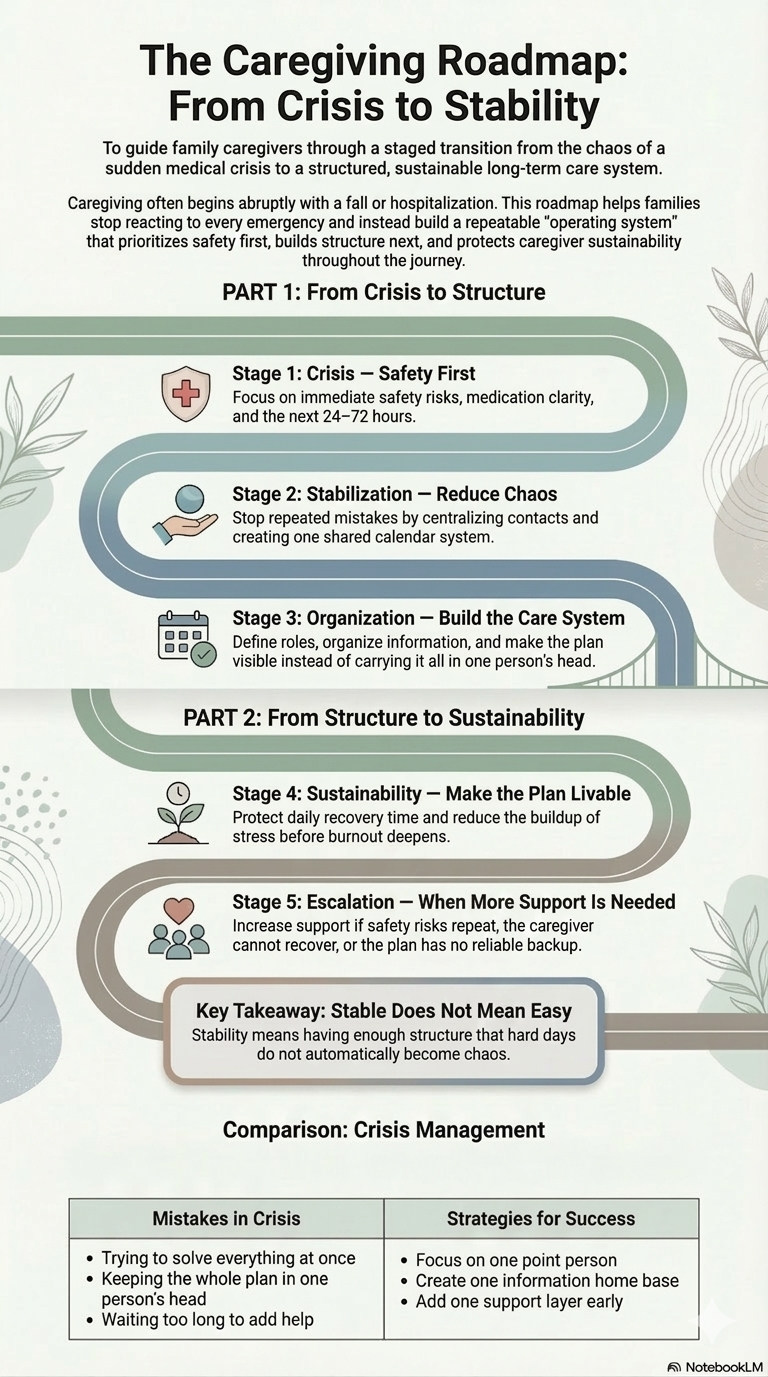
The visual guide above is meant to give you a quick way to see the caregiving journey as a sequence rather than as one giant problem. Many families feel overwhelmed because they are trying to solve a long-term situation while still standing inside an immediate disruption. The roadmap helps separate what belongs to today from what belongs to the next stage.
It also highlights an important truth: stable caregiving does not happen because one person becomes endlessly available. It happens because the family gradually moves from reaction to structure. Safety comes first, organization comes next, and sustainability has to be protected throughout the process so the caregiver does not quietly burn out while holding everything together.
Stage 1: Crisis — Safety First, Clarity Second
The crisis stage is the period when something has changed quickly or dramatically. In this stage, the goal is not long-term planning. The goal is immediate stability: safety, medication clarity, communication, and the next 24–72 hours.
At this stage, families often make one of two mistakes: either trying to plan the entire future before the present is stable, or avoiding decisions completely because everything feels too big. A better question is: “What must be true today for this to be safe?”
- Immediate safety (falls, meds, supervision, transport)
- Clear point person for communication
- Simple written notes on what changed and what happens next
- A plan for the next 24–72 hours only
If you’re in the first shockwave of caregiving, The First 30 Days of Caregiving can help you stabilize the essentials before trying to build something bigger.
Stage 2: Stabilization — Reduce Chaos and Stop Repeating Mistakes
Once the most urgent risks are contained, families move into stabilization. This stage is about reducing preventable confusion. Medication lists need to be clear. Contacts need to be centralized. The family needs to know who is handling what. This is where “holding the whole plan in your head” starts to become a problem.
Stabilization is also where routines begin. Even a small weekly check-in, one calendar, and one notes system can reduce stress quickly. The goal is not elegance. The goal is fewer repeated emergencies.
Stage 3: Organization — Define Roles, Systems, and Expectations
Organization is the stage where caregiving stops being only reactive and starts becoming a system. This is often when the primary caregiver role becomes visible. Someone is tracking appointments, fielding calls, and making sure the next step happens.
The biggest risk here is silent role expansion. One person becomes the organizer, then the default decision-maker, then the emotional anchor for everyone else. If that role is not named and bounded, overload builds quickly.
What It Means to Be the Primary Caregiver can help you define the role in a way that keeps it sustainable instead of letting it expand into “everything.”
- Who owns which category: meds, appointments, paperwork, communication?
- Where is the medical information home base?
- What routine prevents the same problem from happening again?
- What tasks can be delegated or simplified?
Stage 4: Sustainability — Build a Life the Care Plan Can Actually Fit Inside
This is the stage many caregivers skip. They get good at managing the system but never rebuild their own life around it. The result is functioning without recovery. Things look organized on paper, but the caregiver is quietly wearing down.
Sustainability means asking whether the current plan can continue for months, not just days. Does it allow the caregiver to sleep, work, recover, and stay emotionally steady? If the answer is no, the system is not stable yet—it is only temporarily functional.
For a broader operating system that supports this stage, Caregiving for Aging Parents gives you a structured framework for roles, routines, and escalation thresholds.
Where Families Commonly Get Stuck
Families often get stuck between stages. They are no longer in full crisis, but they have not built stable systems either. This creates a draining middle zone where the caregiver feels constantly on alert and never fully off duty.
Another common trap is mistaking short-term survival for long-term viability. If the current plan only works because one person is overfunctioning, the family has not reached stability yet.
How to Know When the Roadmap Needs a New Level of Support
Sometimes families do everything “right” and still cannot reach stability with the current support level. That usually means the issue is not effort. It is care level mismatch. When safety is still unreliable, needs are still escalating, or the caregiver is carrying unsustainable pressure, more help is needed.
Signs Your Parent May Need More Care Than You Can Provide can help you recognize when the next stage is not “try harder,” but “increase support.”
Stability Does Not Mean Easy
It helps to define stability realistically. Stable caregiving does not mean there are no hard days. It means the family has enough structure that hard days do not automatically become chaos. Information is accessible, roles are clearer, and the next step is easier to identify.
That kind of stability is possible, but it usually comes from layered systems and honest limits—not from one heroic caregiver doing everything alone.
Escalation: When “Stability” Is Not Real Yet
Some families tell themselves they are stable because there is no current emergency. But if the plan depends on constant vigilance, poor sleep, or one person carrying everything, it is not stable enough yet.
- Safety is still unreliable despite routines and effort.
- The caregiver cannot recover between days.
- Medication mistakes, falls, or urgent calls are still repeating.
- The plan has no backup if the main caregiver gets sick or unavailable.
In those situations, it may be time to involve a clinician, social worker, care manager, or additional paid/family support so the system can move from survival into true stability.
FAQ
How long does it take to move from crisis to stability?
It varies widely. Some families stabilize key routines within a few weeks, while others need months as health needs and roles become clearer. The more realistic your expectations, the easier it is to build steady progress.
What if I feel like we are stuck in crisis mode?
That usually means too much is still being carried mentally and too little is systematized. Focus on one routine, one home base for information, and one clear point person first.
Can one person manage the whole roadmap alone?
For a short period, maybe. Long term, usually not. Sustainable caregiving almost always requires systems, clearer role boundaries, and some form of support or backup.
What is the most important shift after the first crisis?
Moving from reaction to routine. That is often the point where caregiving begins to feel less chaotic and more manageable.
How do I know which stage we’re in?
Ask what is taking most of your energy. If it is immediate risk, you are in crisis. If it is repeated confusion, you are in stabilization. If it is systems and roles, you are in organization. If it is endurance and sustainability, you are in the long-term stage.
What if my parent’s needs keep changing?
That is common. The roadmap is not rigid. It is a way to orient yourself so you can keep choosing the next right step even when the situation evolves.